

The Distress Cycle Is Here, and Real Estate May Solve it
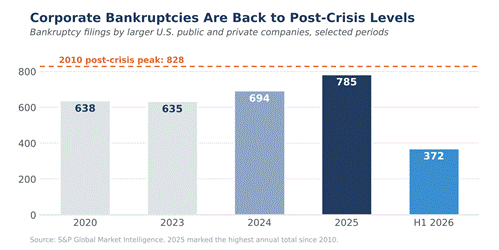
By almost any measure, U.S. corporate distress is running at levels not seen since the aftermath of the financial crisis. S&P Global Market Intelligence counted 785 bankruptcy filings by larger public and private companies in 2025, the highest annual total since 2010 and the third straight yearly increase. The pace has not let up: 372 companies filed in the first half of 2026, the most for any first half in 16 years. PwC notes that tariffs have weighed hardest on consumer products and industrial companies.
The Middle District of Florida, which covers Tampa Bay and Clearwater, saw total filings rise 26.1% in the twelve months through June. It ranked fifth in the country for Chapter 11 cases and first for Subchapter V.
Many filings involve businesses with viable underlying operations but capital structures that no longer work. The businesses are unable to refinance, tripped a financing covenant, or have lost access in a tight capital market. Bankruptcy gives buyers a structured, court-supervised path to those businesses, usually through a competitive auction on a defined timeline. For strategic buyers and financial partners, owned real estate can become an overlooked source of acquisition capital.
Why Bankruptcy Auctions Break Conventional Financing
A bankruptcy auction is a different animal from a negotiated acquisition, and the differences land squarely on the buyer’s financing.
The Clock Belongs to the Debtor. Bid deadlines are set by the court and by how much cash the debtor has left, not by a credit committee calendar. An acquisition loan that needs a quality-of-earnings report, a full appraisal and two rounds of credit approval may simply not fit.
Lenders Underwrite History, and History Is the Problem. Cash-flow lenders size loans on trailing EBITDA. For a company in Chapter 11, trailing EBITDA is usually depressed, distorted by restructuring costs, or both. The result is a smaller loan, a higher price or a pass. A distressed target asks those same lenders to stretch further.
The Seller Penalizes Uncertainty. The estate and its creditors want the highest value they can realistically collect. A bid with a financing contingency is worth less than an equal bid without one, and sometimes less than a lower bid without one. The winner is frequently the bidder who can prove it will close.
Put those together and the buyer faces a compressed timeline, a financing market that discounts the target’s credit and a seller that penalizes contingencies. The buyers who win arrive with committed capital, and the most reliable source of committed capital is often already sitting on the target’s balance sheet.
The Real Estate Is the Financing
Sale-leaseback (“SLB”) financing allows the acquirer to buy the operating business and its owned real estate. At closing, it simultaneously sells the real estate to a net lease investor and signs a long-term, triple-net lease. The proceeds fund part of the purchase, and the company keeps operating in the same facility, now as a tenant.
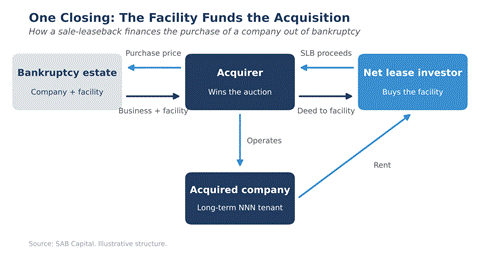
In a distressed acquisition, four features of this structure matter most:
It Is Underwritten Forward, Not Backward. Historical performance matters, but it does not tell the whole story. A net lease investor is underwriting the business under new ownership, the strength of the acquirer’s guaranty, the rent the business can support, and the value of the real estate if the lease ever goes away. The question is not only what the debtor earned yesterday. It is what the property and tenancy look like after the acquisition closes.
It Monetizes the Full Value of the Building. Leveraging the acquirer’s rent guaranty under a 10-20-year lease, a sale-leaseback can monetize 100% of the real estate value at closing. By comparison, conventional real estate financing may advance 65%-70% of the property’s appraised value. Where the new lease and quality of tenancy also support a higher leased valuation, sale-leaseback proceeds can be materially greater, unlocking 1.5x-3.0x the debt proceeds otherwise available against the same real estate. That additional liquidity preserves borrowing capacity for the acquirer to fund working capital, replenish inventory, address order backlogs and complete deferred CapEx.
It Can Move at Auction Speed. Experienced net lease buyers underwrite and close in weeks, and many can close in under 30 days when a deal requires it. A committed term sheet can accompany the bid itself.
It Replaces a Maturity with a Lease. A 10- to 20-year lease with renewal options carries no balloon payment and no refinancing event three years after a restructuring, while the business is still rebuilding.
This Structure Has Been Proven at Scale
Separating the operating business from the real estate inside a bankruptcy is not new. When HCR ManorCare, then the second-largest nursing home operator in the country, went through a pre-packaged Chapter 11 in 2018, Welltower agreed to acquire approximately $1.95 billion of real estate. The properties were leased back to ProMedica on a 15-year absolute triple-net master lease at an 8% initial yield and 1.8x rent coverage. The operator acquired the business, the capital partner bought the buildings, and both transactions closed together, with rent sized to the post-acquisition business rather than the purchase price.
J.C. Penney followed a similar playbook coming out of Chapter 11. Simon Property Group and Brookfield acquired the retail operations, while 160 stores and six distribution centers were separated into a property trust and leased back to the new operator under two triple-net master leases. The structure allowed the buyers to take control of a national retailer without having to fund or finance the full value of the underlying real estate themselves.

In October 2026, SAB arranged a $24MM SLB for an industry-leading plastics manufacturer that purchased the assets of a Florida-based tool & die manufacturer out of a court-supervised Section 363 asset sale. The SLB financing supported a strategic add-on acquisition to expand domestic manufacturing capabilities and reshore tool & mold production currently outsourced to European and Asian supply chains. The SLB financed more than 50% of the entire asset purchase.
Conclusion
Distress creates the opportunity, but the real estate often decides who can act on it. In a bankruptcy auction, the acquirer that treats the target’s building as committed capital rather than one more line in the purchase price can bid with more certainty, less buyer equity and a faster path to close. The largest restructurings of the last decade proved the structure at the billion-dollar level. SAB’s recent Florida transaction shows it works just as well for a middle-market manufacturer on a two-month timeline.
SAB Capital scores acquisition targets’ owned and leased properties. Just as a QofE scores earnings quality, SAB’s Quality of Leasehold (“QofL”) process diligences the target’s full property fleet. It covers what the owned buildings are worth to a net lease investor, which leases are worth keeping, and how quickly that value can be turned into committed capital. In a court-supervised sale, where the buyer typically selects which leases are assumed and which are left behind, that diligence belongs in the bid, not after it. With bankruptcies at their highest level in more than a decade, the buyers best positioned to win will proactively recruit professional advisors early in the process to convert the property fleet into committed capital to drive EBITDA and expand market share.
If you’re evaluating an acquisition and want to understand how the target’s owned and leased real estate could help finance it, please reach out to our QofL Advisory team.